Document Type : Original Article
Authors
1
Ph.D. Student of Architecture, Department of Architecture, Tourism, Architecture and Urban Research Center, ISF.C., Islamic Azad University, Isfahan, Iran.
2
Associate Professor, Department of Architecture, Tourism, Architecture and Urban Research Center, ISF.C., Islamic Azad University, Isfahan, Iran.
3
Assistant Professor, Department of Architecture, Tourism, Architecture and Urban Research Center, ISF.C., Islamic Azad University, Isfahan, Iran.
4
Assistant Professor, Department of Architecture, Abhar, Islamic Azad University, Abhar, Iran.
Abstract
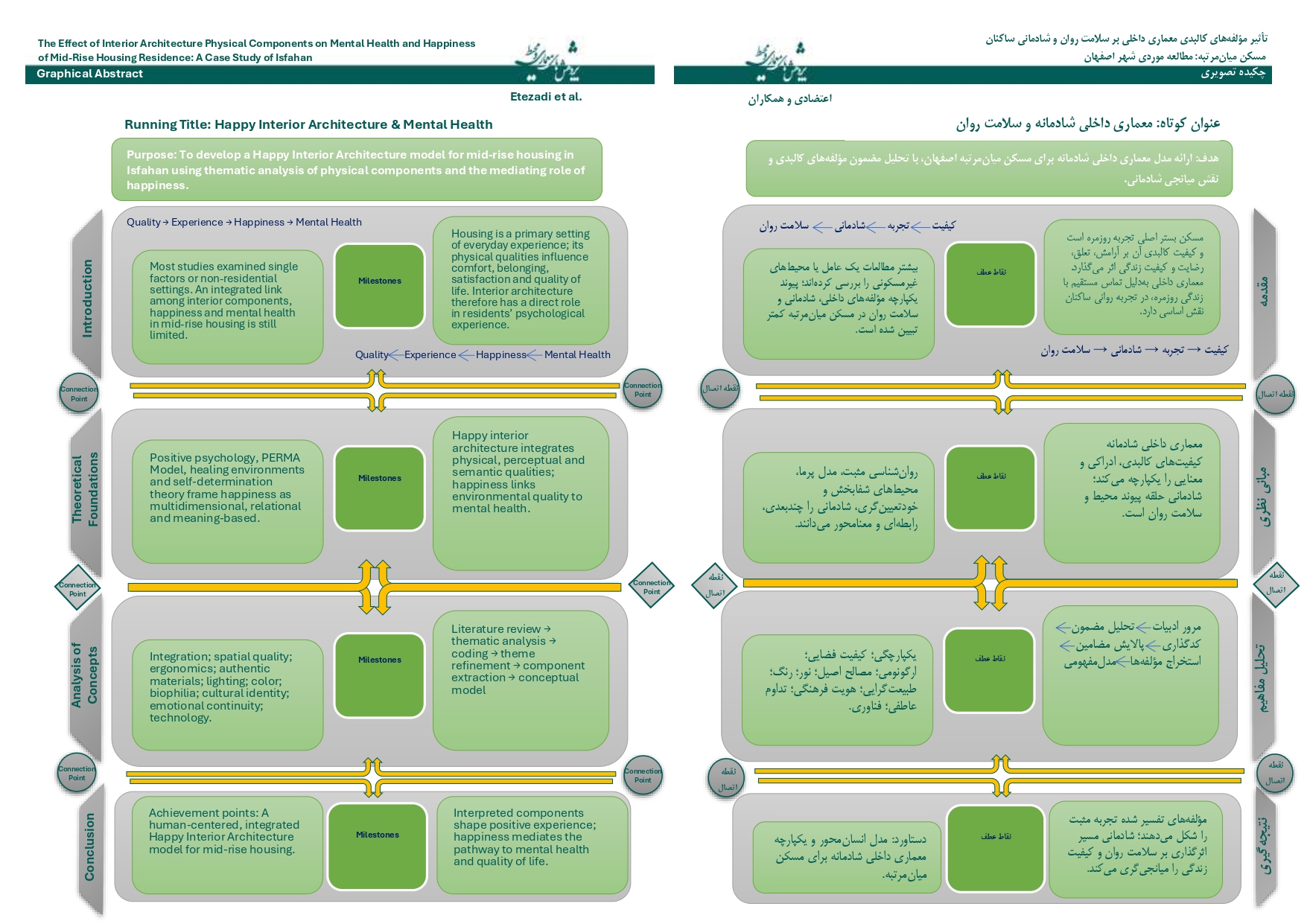
Housing, as one of the most significant settings of human lived experience, extends beyond the provision of functional needs and plays a crucial role in shaping residents’ sense of comfort, belonging, satisfaction, and overall quality of life. In contemporary architectural approaches, increasing attention to the physical characteristics of space and their influence on human psychological conditions has contributed to the emergence of human-centered and health-oriented perspectives in architectural design. This study aims to develop a Happy Interior Architecture Design Model for mid-rise residential environments in Isfahan, based on analyzing the effects of physical architectural components on residents’ mental health and examining the mediating role of happiness. The research is applied in terms of purpose and qualitative in terms of methodology. Through thematic analysis and an examination of experts’ perspectives, the study identifies the key components influencing interior architectural quality and organizes them within a conceptual framework. The findings demonstrate that the quality of happy interior architecture emerges from the interaction among the physical, perceptual, and semantic dimensions of space. The analysis identified several key components as influential factors in residents’ mental health, including design integration; spatial quality and organization; interactive and responsive spatial layout; authentic and natural materials; lighting quality and environmental perception; spatial biophilia; color balance; cultural identity; emotional continuity with the environment; and the integration of technology into everyday life. Furthermore, the findings indicate that happiness, as a mediating variable, strengthens the relationship between the quality of physical architectural components and residents’ mental health. Based on these findings, the proposed model conceptualizes happy interior architecture as a human-centered design system that contributes to improving residents’ mental health by enhancing environmental perception, fostering a sense of belonging, strengthening social interactions, and generating positive spatial experiences. The proposed model can serve as both a theoretical and practical framework for the design of mid-rise residential environments with an emphasis on enhancing residents’ quality of life.
Graphical Abstract
Keywords