Document Type : Original Article
Authors
1
M.Sc. Graduate, Architecture, Faculty of Technology and Engineering, University of Zanjan, Zanjan, Iran.
2
M.Sc. Graduate, Architecture, Faculty of Technology and Engineering, University of Mohaghegh Ardabili, Ardabil, Iran.
Abstract
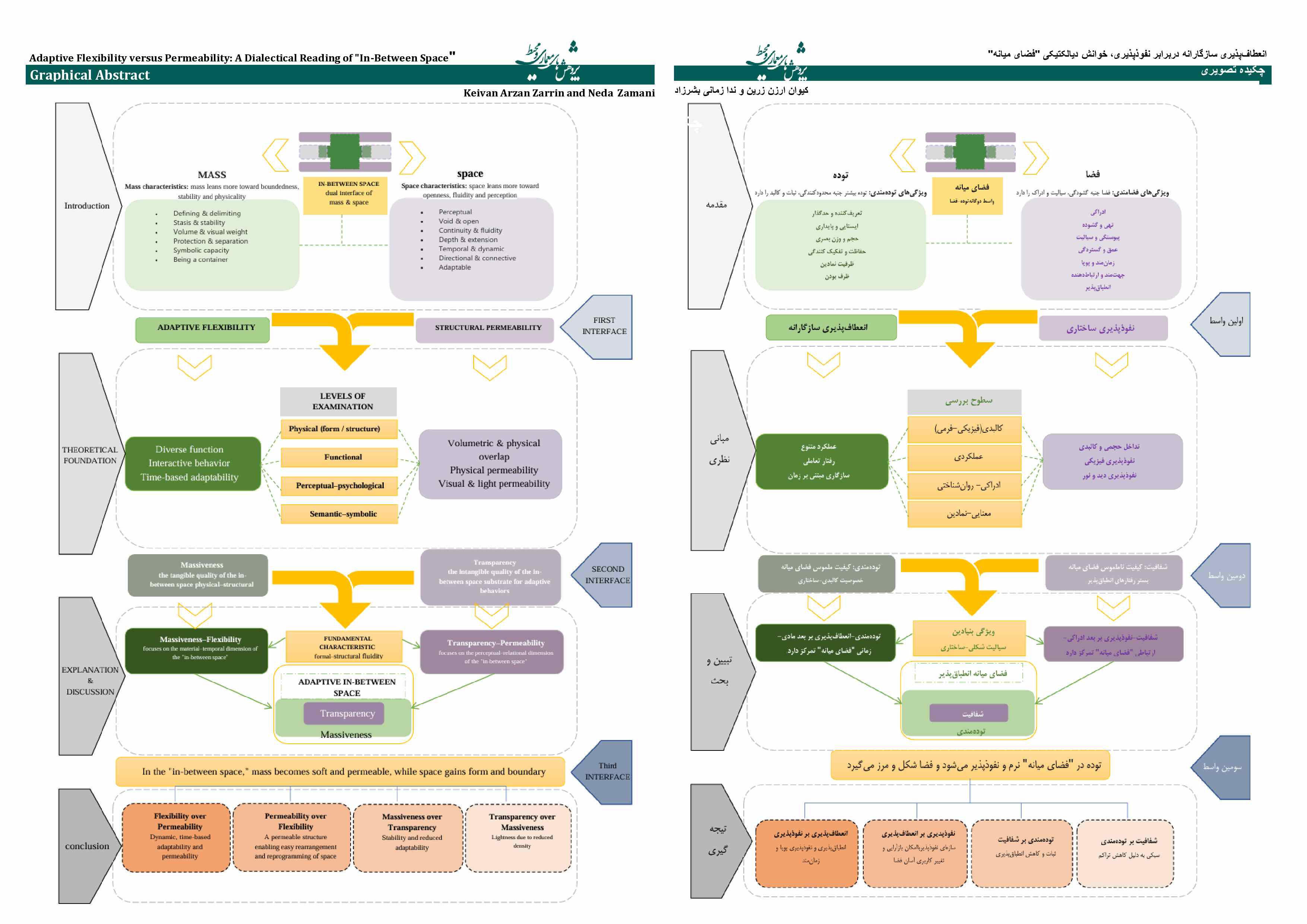
As an interface, the "in-between space" transforms the mass-space duality into tangible and intangible qualities that, interwoven together, generate the overall form of the in-between space. Through its formal-structural fluidity, the in-between space brings forth and displays two foundational concepts of adaptable spaces: permeability and flexibility. Through its agency as a connector and interface, and as the organizer of the mass-space system, the "in-between space" constitutes the most fundamental pillar in the formation of architecture. However, neglecting its essential characteristics in combination with other factors involved in architectural structures renders it ineffective and devoid of formal, functional, and semantic qualities. Accordingly, the two essential pillars of "transparency" and "massiveness," through the agency of the two features "adaptive flexibility" and "structural permeability," achieve greater compatibility with the concept of "in-between space" within the context of architectural formation. The present research is fundamental in terms of content analysis and is qualitative in nature; based on analytical-descriptive strategies, it explains the characteristics of the concept of "in-between space" in architectural structures and requires an examination of the components influencing it. Accordingly, first a precise definition of the in-between space is provided, drawing on the concepts and foundations underlying its formation. Following this, its levels of formation are examined in the form of the physical (physical-formal) level, the functional level, the perceptual-psychological level, and the semantic-symbolic level. To read these levels, it is necessary to explain two general concepts: structural permeability and adaptive flexibility in the in-between space. The main characteristic and property of these concepts are the two foundational keywords, namely spatial "massiveness" and "transparency," which are vital and essential in the formation of the "adaptable in-between space." The result of the present research clarifies "massiveness" as the receiving vessel for "transparency," which manifests in the form of a physical-structural property, accommodates adaptive and adaptable functions and behaviors within the "in-between space," and gives rise to perceptual and semantic actions.
Graphical Abstract
Keywords