Architectural and Environmental  Research

Architectural and Environmental Research

The Effects of Classroom Color, Spatial Layout, and Decorative Elements on Students' Psychological Well-Being: An Environmental Psychology Perspective

Document Type : Original Article

Authors
1 M.Sc. Graduate in General Psychology, Islamic Azad University, Karaj, Iran.
2 Ph.D. Student in Architecture, Department of Architecture, Islamic Azad University, Saveh, Iran.
3 Assistant Professor, Department of Architecture, Sav. C., Islamic Azad University, Saveh, Iran.
Abstract
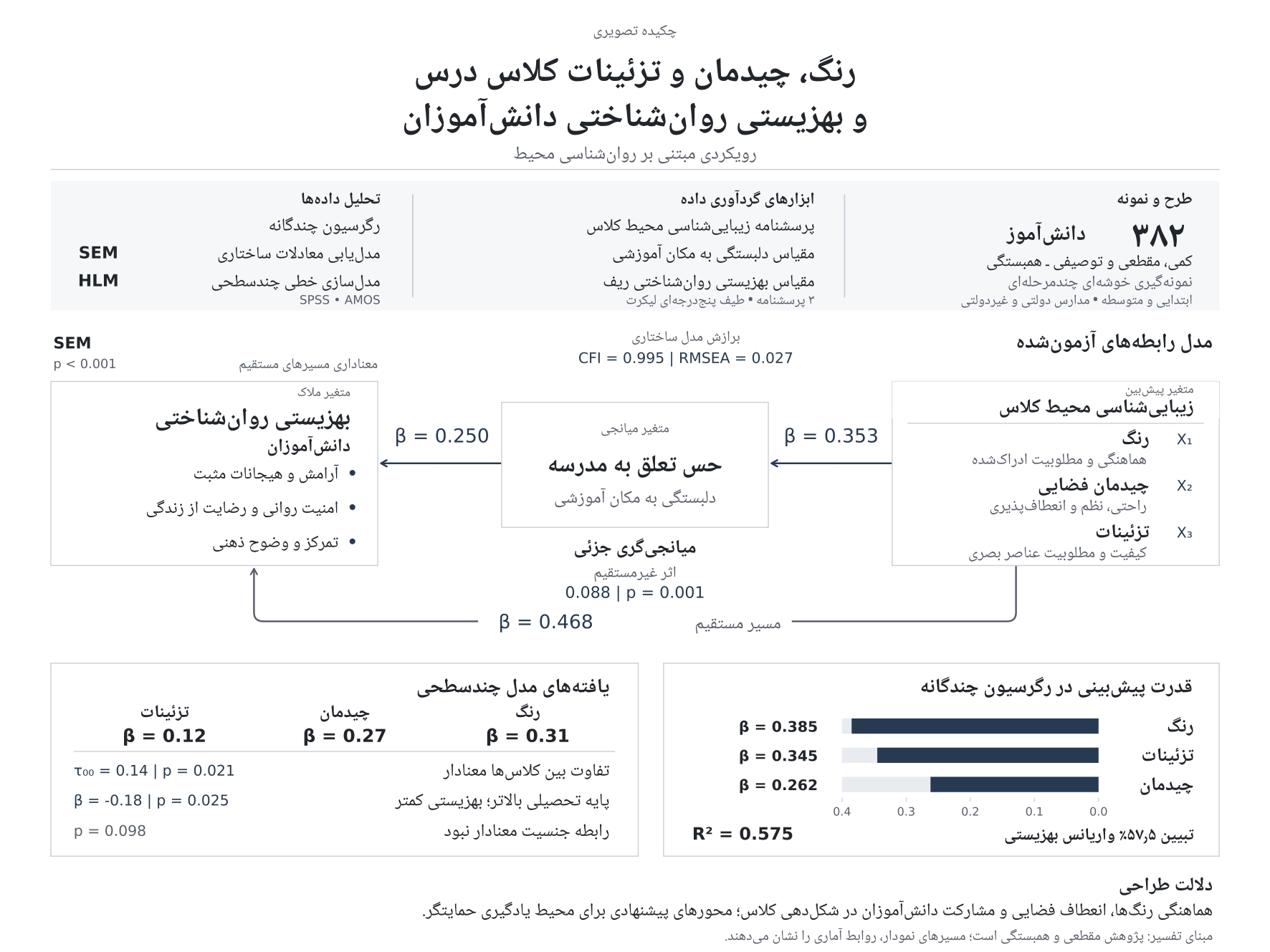
Learning environments play a foundational role in students' cognitive and psychological development; however, previous studies have predominantly examined physical attributes in isolation and overlooked the nested structure of school data, leaving the concurrent mechanisms linking visual-physical indicators and school belonging to students' mental well-being insufficiently explained. This study aimed to investigate the relationship between classroom aesthetic dimensions (color, spatial layout, and decorative elements) and students' psychological well-being, while testing the mediating role of a sense of school belonging and accounting for classroom-level variations. A descriptive-correlational research design was employed. The study population comprised students across various educational levels, from whom 382 participants were selected using multistage cluster sampling. Data were collected using Ryff's Scales of Psychological Well-Being, the Place Attachment Scale, and a researcher-developed Classroom Environmental Aesthetics Questionnaire, and were analyzed using Structural Equation Modeling (SEM) and Hierarchical Linear Modeling (HLM). The findings revealed that all aesthetic components were positively and significantly associated with psychological well-being, with color emerging as the strongest predictor (β = 0.385). Furthermore, students' sense of school belonging played a significant partial mediating role in this link (indirect effect = 0.088). Multilevel analysis further corroborated the presence of significant between-classroom variance and a modest decline in well-being across higher educational levels, whereas gender did not exert a statistically significant effect. Overall, these findings demonstrate that classroom aesthetic variables—particularly color quality and spatial flexibility—not only directly enhance students' psychological well-being, but also exert part of their positive influence through deepening emotional attachment and a sense of belonging to the school environment.

Graphical Abstract

The Effects of Classroom Color, Spatial Layout, and Decorative Elements on Students Psychological Well-Being: An Environmental Psychology Perspective
Keywords

Volume 4, Issue 6 - Serial Number 6
Spring and Summer 2026
September 2026

  • Receive Date 06 August 2026
  • Revise Date 29 September 2026
  • Accept Date 29 September 2026
  • Publish Date 23 August 2026