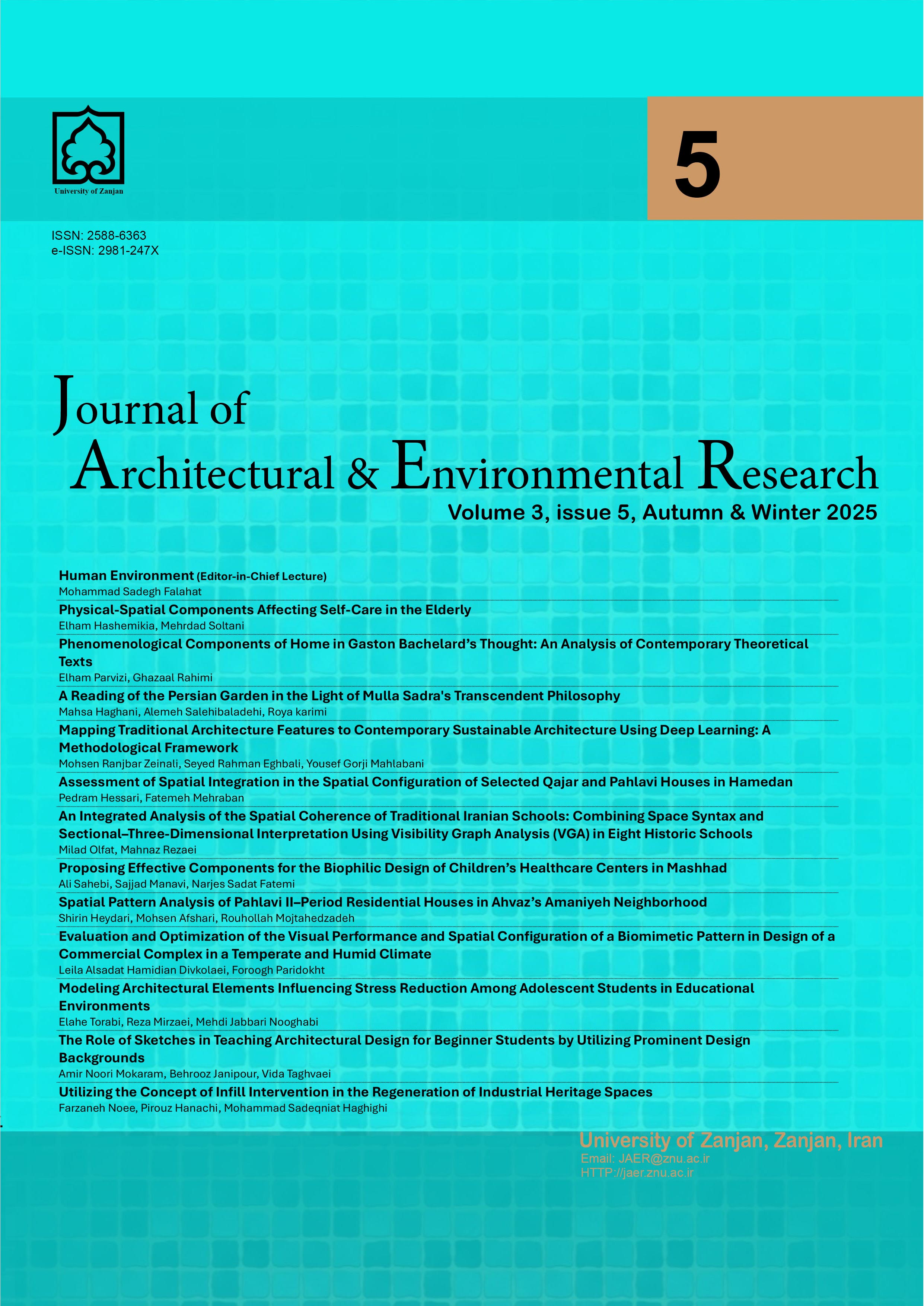
“Place” is the very essence of architecture; it is imbued with cognition and consciousness. Place both perceives and reveals. It is the soul of architecture, born from the heart of relationships; it captures the nexus of concepts and brings them into manifestation. Place severs and binds; it is the connecting link between two fundamental entities: humankind and the cosmos, man and the universe. What draws us closer to the authentic concept of place today is “environmental-human architecture,” or more simply, the “human environment.” The human environment is the ultimate telos (culmination) of architecture, the outcome of the intertwining of habitat and humanity. It is the discovery and reflection of this interwovenness that simultaneously looks toward both the “habitat” and the “human.” At its genesis, architecture either gazes upon humanity—becoming “human architecture,” which nurtures and preserves the human being—or it is oriented toward the environment—becoming “environmental architecture,” which imparts meaning to and safeguards the human habitat. Yet, the “human environment” is place itself; a realm where no boundary exists between human “being” and “becoming.” In the human environment, “habitat” is “being,” and “being” is “habitat”; in other words, this is the very “green place.” In alignment with this vision, the Journal of Architectural and Environmental Research explores the concept of the human environment in its quest for place as the core of architecture. Through the dual facets of environmental architecture and human architecture, this journal contemplates these concepts and their bond to attain the ideal of the “green place.” In this issue, three articles address “Architecture and Environment,” five articles investigate “Architecture and Human,” and four articles guide us toward a more profound understanding of the “Human Environment.” Let us read and immerse ourselves together.