Document Type : Original Article
Authors
1
-Master's Degree in Architectural Technology, Bionic Architecture, University of Kashan, Kashan, Iran.
2
Associate Professor, Faculty of Architecture and Art, University of Kashan, Kashan, Iran.
Abstract
Increasing energy consumption, decreasing environmental quality, and uniformity of contemporary architectural spaces have made the necessity of reviewing design approaches and utilizing efficient natural patterns more evident than ever. In the meantime, bionic architecture, inspired by mechanisms found in nature, provides a suitable basis for achieving innovative and sustainable solutions. Sunflower plant, due to its characteristics such as heliotropism, responsiveness to environmental conditions, coherent structure of components, and special geometric proportions, can be used as a suitable model in interactive architecture. The aim of this research is to identify and extract transferable design principles from sunflower adaptive mechanisms and explain their application in interactive architecture with an emphasis on enhancing the sense of place. The present research is of an applied type and has been conducted with a descriptive-analytical approach. Data collection was carried out using a library method, and then by examining the biological and structural characteristics of sunflower, principles that can be exploited in architecture were extracted and analyzed. The findings of the study show that features such as movement dynamics, adaptation to environmental conditions, structural coherence, structural compactness, and geometric proportions of sunflowers have the potential to be transformed into design strategies in interactive architecture. Also, the results of adapting these principles to the dimensions of interactive architecture and components of sense of place show that these strategies can be effective in enhancing the sense of place by increasing the flexibility and responsiveness of space, improving environmental comfort, and the quality of spatial experience. Finally, this study provides a conceptual framework to transform the adaptive mechanisms of sunflowers into design strategies in interactive architecture with an emphasis on enhancing the sense of place.
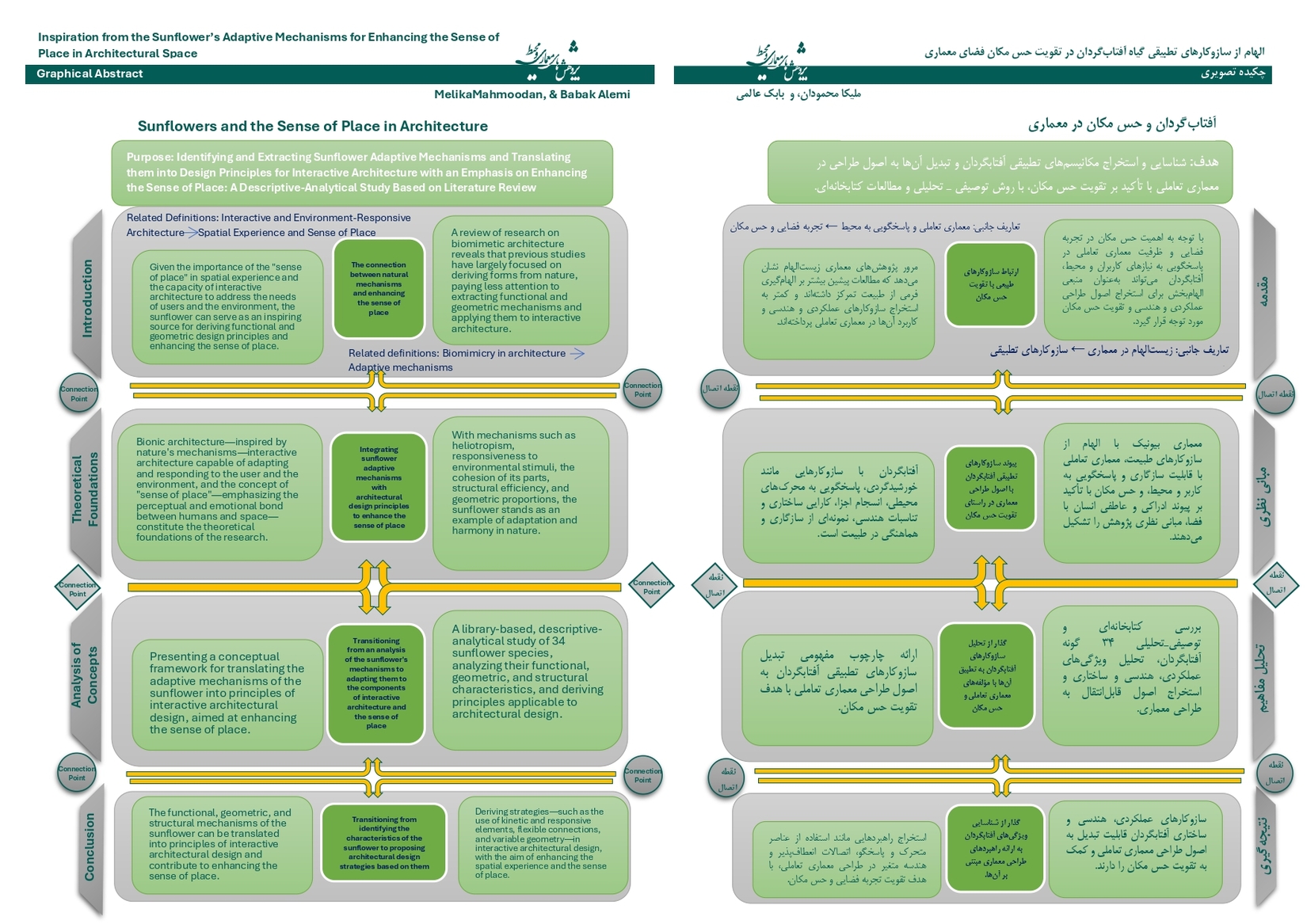
Graphical Abstract
Keywords