Document Type : Original Article
Authors
1
Ph.D. Student of Architecture, Faculty of Architecture and Urban Planning, Art University of Isfahan, Isfahan, Iran.
2
Associate Professor, Department of Architecture, Faculty of Architecture and Urban Planning, Hakim Sabzevari University, Sabzevar, Iran.
3
Assistant Professor, Department of Architecture, Faculty of Architecture and Urban Planning, Art University of Isfahan, Isfahan, Iran.
4
Associate Professor, Department of Psychology, Faculty of Humanities, University of Isfahan, Isfahan, Iran.
Abstract
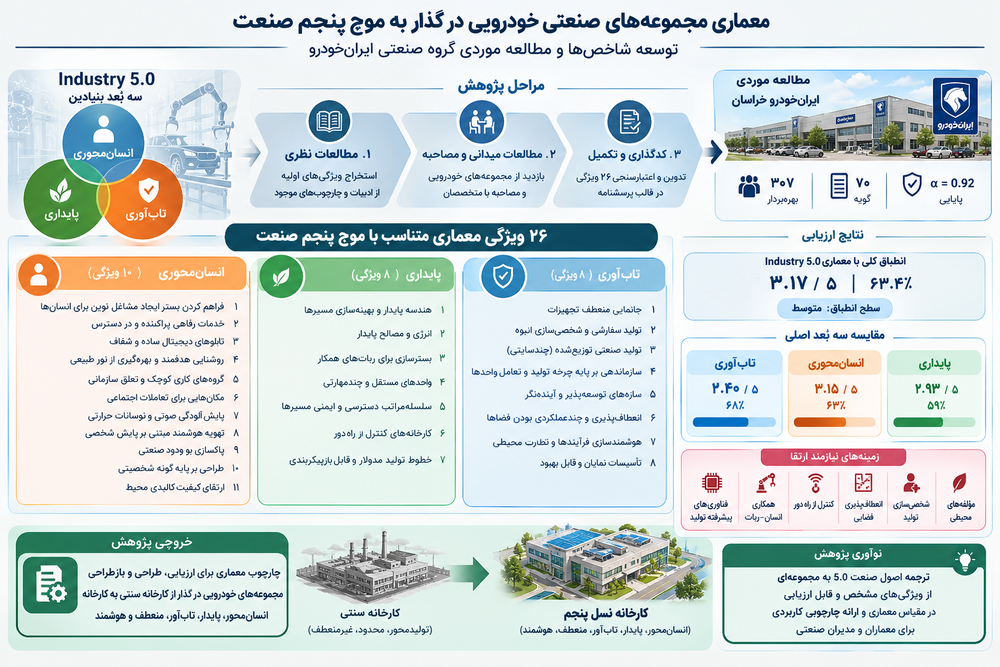
Purpose: The transition from Industry 4.0 to Industry 5.0, with an emphasis on human-centricity, sustainability, and resilience, introduces new requirements for the spatial organization and architecture of industrial complexes. This study aims to develop architectural features for Iranian automotive production complexes aligned with Industry 5.0 and assess the extent to which a case study in Iran conforms to these features.
Method: This mixed-methods study was conducted in three stages. First, architectural features of Industry 5.0 identified and conceptualized in a previous study were used as the initial framework. Second, complementary and context-specific architectural features were identified through field visits to several automotive production complexes and interviews with managers of different automotive complexes. Qualitative data were analyzed through open and axial coding, and the initial framework was refined. Third, the final framework was operationalized in a questionnaire administered to 307 employees of the Iran Khodro Industrial Group to assess the conformity of the complex with the identified Industry 5.0 architectural features.
Findings: The findings resulted in a framework of architectural features addressing human-centricity, sustainability, resilience, flexibility, and spatial adaptability to emerging technologies. The assessment of Iran Khodro identified the extent to which these features have been realized and highlighted areas requiring further improvement.
Conclusion: Industry 5.0 architecture in automotive complexes requires a transition from purely production-oriented spaces toward environments that are human-centered, flexible, sustainable, and resilient. The proposed framework can provide a basis for evaluating and redesigning automotive production complexes and guiding future architectural interventions in the transition toward Industry 5.0.
Graphical Abstract
Keywords