Architectural and Environmental  Research

Architectural and Environmental Research

Journal Archive

Autumn and Winter 2025-2026
Spring and Summer 2025


Number of Volumes 3
Number of Issues 5
Number of Articles 68
Number of Contributors 128
Article View 80,556
PDF Download 58,400
View Per Article 1184.65
PDF Download Per Article 858.82
Number of Submissions 249
Rejected Submissions 103
Rejection Rate 41
Accepted Submissions 68
Acceptance Rate 27
Number of Indexing Databases 17
Number of Reviewers 72

The Journal of Architectural and Environmental Research actively solicits high-quality, fundamental, and profound qualitative research within the realms of architecture and urbanism. We invite scholarly contributions focusing on: Human Environments, the Anthropology of Place, Socio-Cultural and Bio-Ecological Settlements, Spatial Sustainability, the Meaning of Place, and the Underlying Concepts and Foundations of Place.


The Journal of Architectural and Environmental Research follows the principles of (COPE) in scientific publishing ethics.


To facilitate access for students, researchers, and professionals, the Journal of Architectural and Environmental Research provides free and open access to all articles on its website.


 To cover essential administrative costs, the journal charges a total fee of €3 for manuscript evaluation and publication, structured as follows:

  • Initial Processing Fee: €1 (payable upon submission)
  • Article Processing Charge (APC): €2 (payable upon final acceptance)


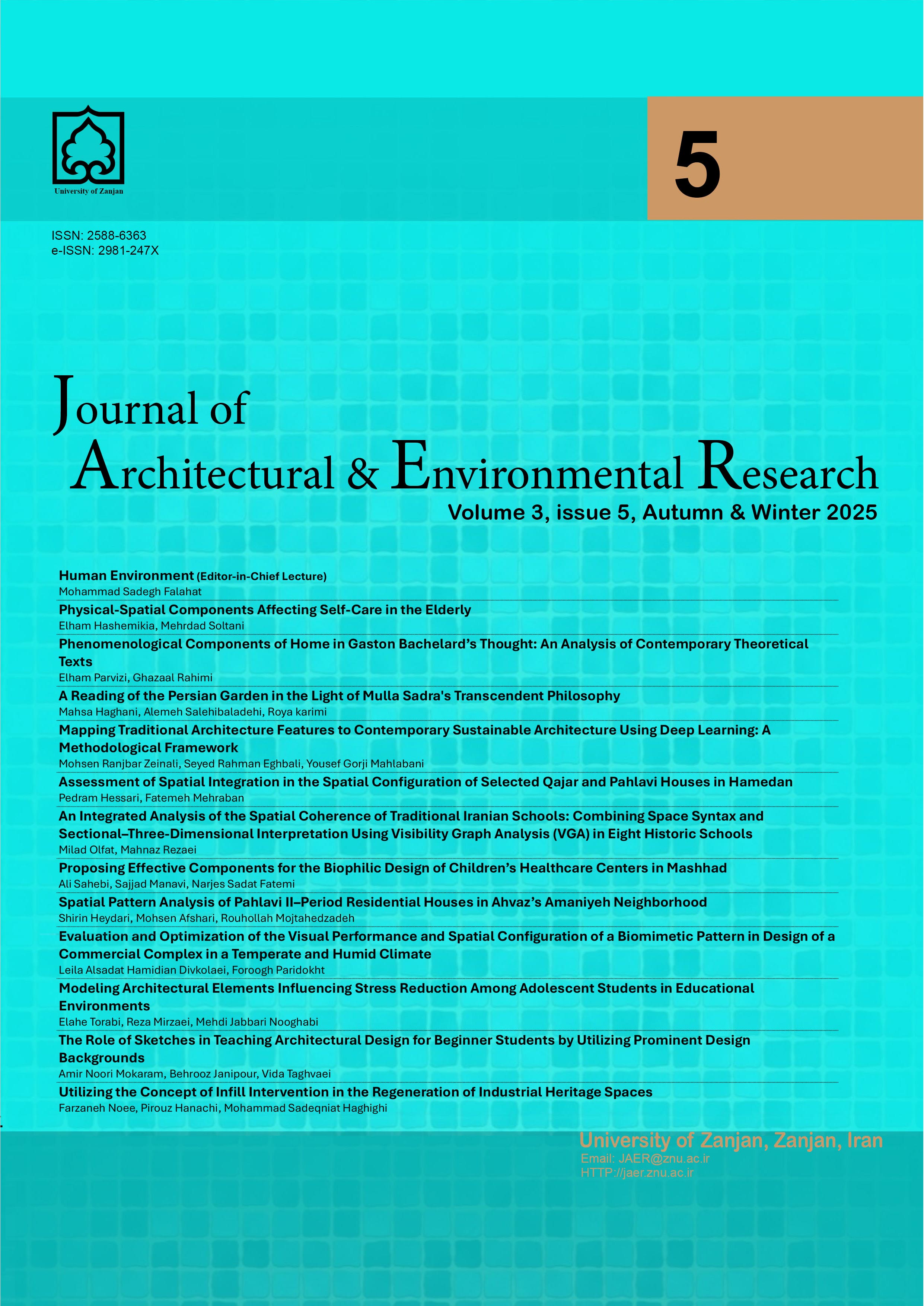
Current Issue: Volume 3, Issue 5, March 2026 (Autumn and Winter 2025-2026) 

Keywords Cloud

  • Phenomenology
  • Thermal comfort
  • Spatial quality
  • Traditional architecture
  • genetic algorithm
  • Environmental Psychology
  • Tabriz
  • Embodiment
  • Shiraz
  • Place Attachment
  • Space Syntax
  • Space
  • home
  • nature
  • Perception
  • hot-arid climate
  • Lived Experience
  • Architectural Design
  • Elderly
  • Architectural Design Process
  • Urban Space
  • Architecture
  • Industrial Heritage
  • Self-Care
  • Saliency
  • Adaptive reuse
  • Social Capital
  • Spatial Logic
  • Spatial Heterogeneity
  • In-Between space
  • place and spatiality
  • interior architecture
  • mechanism of carving
  • unity
  • happiness
  • Visual Control
  • Architect Training
  • Environment-Behavior Studies
  • Biomimetic Design
  • Human-Centered Design
  • Human institutions
  • Gradation of being
  • urban poverty
  • urban design
  • public spaces
  • residential buildings
  • Cultural Anthropology
  • Visual Performance
  • Environmental perception
  • Spatial Intimacy
  • spatial of Kerman Shahzadeh Garden
  • Skylight
  • street
  • Traditional Iranian Schools
  • physical environment
  • Interactive Architecture
  • Maragheh
  • Architectural Feature Mapping
  • experimental-aesthetic component
  • Infill Intervention
  • Procedural- Content Features of Education of Architecture
  • Pahlavi House
  • meaning
  • home management
  • Intimacy of space
  • High schools
  • Sensitivity analysis
  • Spatial Perception
  • Local Identity
  • Architecture&‌‌‌‌ndash
  • explosion
  • Beaux-Arts education system
  • Mother-child class
  • Amaniyeh Neighborhood
  • emotion
  • Content Analysis
  • Biophilic Design
  • traditional city
  • Fundamental Architectural Design Elements
  • clients\'؛ s attitude
  • Phenomenology of Place
  • Land Ownership
  • Modern Neighborhood
  • Vista
  • Mid-Rise Housing
  • Sense of place
  • Saadi\'s tomb
  • virtual reality
  • \"Persian Garden\"
  • Pahlavi II Architecture
  • artificial intelligence
  • PMV
  • Salingrus
  • functional component
  • housing
  • child education
  • Evaluation
  • the emergence of the place
  • Local Stories
  • Kafshgiri Village
  • theory of constructed emotions
  • Keywords: Phenomenology
  • CPTED
  • design criteria
  • MICMAC analysis
  • Historical site
  • House
  • Traditional Neighborhood
  • Energy Simulation
  • Envi-met 3.1
  • lifestyle
  • Physical Quality of Schools
  • The foundation of the place
  • Painting
  • Education System
  • Urban Management
  • Child psychological well-being
  • Residential Complex
  • Adolescent Academic Stress
  • Social Wealth
  • security feeling
  • Production of space
  • Pathway edges quality
  • separation anxiety
  • Parametric design
  • treatment room
  • Accessibility
  • capability
  • Children\'s separation anxiety
  • Bushehr port
  • Integrated Architecture
  • the System of Education of Architecture
  • Formal Typology
  • Leisure
  • Optimization
  • Ahvaz
  • tomb typology
  • Tehran
  • Sanandaj
  • Narrative Architecture
  • place
  • Spatial Plan
  • audiences\' mental image
  • Gaston Bachelard
  • design
  • urban development
  • Cold Climate
  • Daylight and Energy performance
  • environmental design
  • \"Landscape Sustainability\"
  • Multisensory
  • Pattern Language
  • Iranian architecture
  • natural light
  • Aging
  • Urban neighborhood
  • Crisis
  • Qajar House
  • Urban Degradation
  • public space
  • tomb
  • Ottoman hammams
  • general and conceptual idea
  • Space syntax analysis
  • pedestrian routs of Shahid Chamran University of Ahvaz
  • Approaching
  • Living Structures
  • Housing Spatial Organization
  • Intimacy
  • Passive defense
  • Nursing Homes
  • Academic architecture education
  • adaptive flexibility
  • environmental component
  • Spatial Vitality
  • Urban Residency
  • Ecological Architecture
  • Affordance
  • Architectural Memorability
  • Architectural Training
  • Contemporary Sustainable Architecture
  • Site Museum
  • sunflower
  • Design Ideation
  • \"Environmental Sustainability\"
  • Climatic Factors
  • Conceptual design
  • \"Dolatabad Garden of Yazd\"
  • Visual Expression
  • Children&‌‌‌‌‌rsquo
  • Citizenship
  • Urban Monument
  • Ancient site
  • public participation
  • Industrial Architectural Heritage
  • 15 Khordad Square
  • Elder- friendly park
  • Heterotopia
  • Key words: Islamic work of art
  • the oasis features

Related Journals