پژوهش‌های معماری و محیط

پژوهش‌های معماری و محیط

الهام از سازوکارهای تطبیقی گیاه آفتاب‌گردان در تقویت حس مکان فضای معماری

نوع مقاله : مقاله پژوهشی

نویسندگان
1 ‌دانش‌آموخته‌ی کارشناسی ارشد، فناوری معماری، معماری بیونیک، دانشگاه کاشان، کاشان، ایران.
2 دانشیار، دانشکده معماری و هنر، دانشگاه کاشان، کاشان، ایران.
چکیده
افزایش مصرف انرژی، کاهش کیفیت‌های محیطی و یکنواختی فضاهای معماری معاصر، ضرورت بازنگری در رویکردهای طراحی و بهره‌گیری از الگوهای کارآمد طبیعی را بیش از پیش آشکار ساخته است. در این میان، معماری بیونیک با الهام از سازوکارهای موجود در طبیعت، زمینه مناسبی برای دستیابی به راهکارهای نوآورانه و پایدار فراهم می‌آورد. گیاه آفتابگردان به دلیل برخورداری از ویژگی‌هایی نظیر خورشیدگردی، واکنش‌پذیری نسبت به شرایط محیطی، ساختار منسجم اجزا و تناسبات هندسی ویژه، می‌تواند به عنوان الگویی مناسب در معماری تعاملی مورد استفاده قرار گیرد. هدف این پژوهش، شناسایی و استخراج اصول طراحی قابل انتقال از مکانیسم‌های تطبیقی آفتابگردان و تبیین کاربرد آن‌ها در معماری تعاملی با تأکید بر تقویت حس مکان است. پژوهش حاضر از نوع کاربردی بوده و با رویکرد توصیفی ـ تحلیلی انجام شده است. گردآوری اطلاعات به روش کتابخانه‌ای صورت گرفته و در ادامه با بررسی ویژگی‌های زیستی و ساختاری آفتابگردان، اصول قابل بهره‌برداری در معماری استخراج و تحلیل شده‌اند. یافته‌های پژوهش نشان می‌دهد که ویژگی‌هایی نظیر پویایی حرکتی، سازگاری با شرایط محیطی، انسجام ساختاری، فشردگی سازه‌ای و تناسبات هندسی آفتابگردان قابلیت تبدیل به راهبردهای طراحی در معماری تعاملی را دارند. همچنین، نتایج تطبیق این اصول با ابعاد معماری تعاملی و مؤلفه‌های حس مکان نشان می‌دهد که این راهبردها می‌توانند با افزایش انعطاف‌پذیری و پاسخگویی فضا، بهبود آسایش محیطی و کیفیت تجربه فضایی، در تقویت حس مکان مؤثر باشند. در نهایت، این پژوهش با ارائه چارچوبی مفهومی، زمینه تبدیل مکانیسم‌های تطبیقی آفتابگردان به راهبردهای طراحی در معماری تعاملی با تأکید بر تقویت حس مکان را فراهم می‌کند.

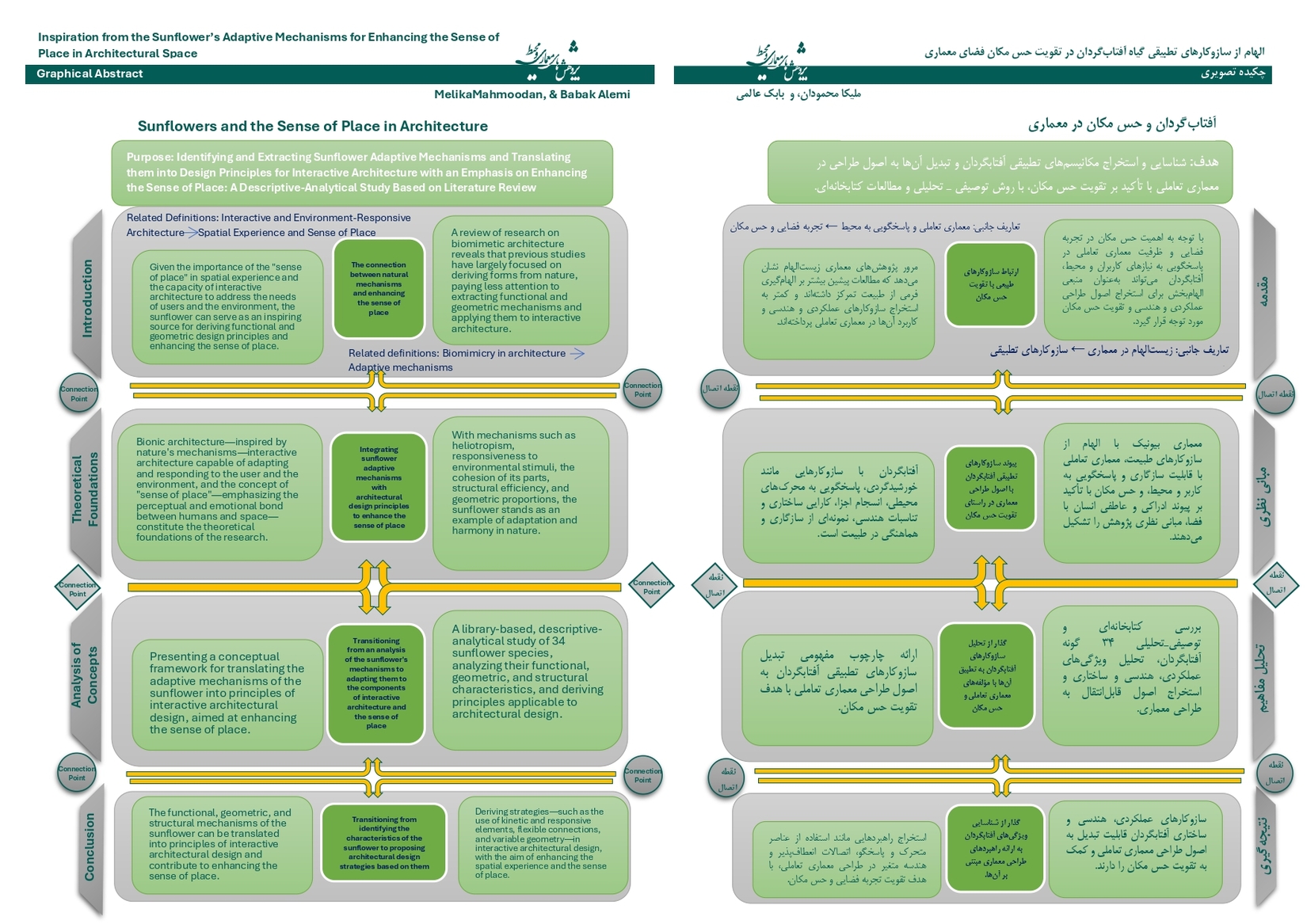
چکیده تصویری

الهام از سازوکارهای تطبیقی گیاه آفتاب‌گردان در تقویت حس مکان فضای معماری
کلیدواژه‌ها

عنوان مقاله English

Inspiration from the Sunflower’s Adaptive Mechanisms for Enhancing the Sense of Place in Architectural Space

نویسندگان English

Melika Mahmoodan 1
Babak Alemi 2
1 -Master's Degree in Architectural Technology, Bionic Architecture, University of Kashan, Kashan, Iran.
2 Associate Professor, Faculty of Architecture and Art, University of Kashan, Kashan, Iran.
چکیده English

Increasing energy consumption, decreasing environmental quality, and uniformity of contemporary architectural spaces have made the necessity of reviewing design approaches and utilizing efficient natural patterns more evident than ever. In the meantime, bionic architecture, inspired by mechanisms found in nature, provides a suitable basis for achieving innovative and sustainable solutions. Sunflower plant, due to its characteristics such as heliotropism, responsiveness to environmental conditions, coherent structure of components, and special geometric proportions, can be used as a suitable model in interactive architecture. The aim of this research is to identify and extract transferable design principles from sunflower adaptive mechanisms and explain their application in interactive architecture with an emphasis on enhancing the sense of place. The present research is of an applied type and has been conducted with a descriptive-analytical approach. Data collection was carried out using a library method, and then by examining the biological and structural characteristics of sunflower, principles that can be exploited in architecture were extracted and analyzed. The findings of the study show that features such as movement dynamics, adaptation to environmental conditions, structural coherence, structural compactness, and geometric proportions of sunflowers have the potential to be transformed into design strategies in interactive architecture. Also, the results of adapting these principles to the dimensions of interactive architecture and components of sense of place show that these strategies can be effective in enhancing the sense of place by increasing the flexibility and responsiveness of space, improving environmental comfort, and the quality of spatial experience. Finally, this study provides a conceptual framework to transform the adaptive mechanisms of sunflowers into design strategies in interactive architecture with an emphasis on enhancing the sense of place.

کلیدواژه‌ها English

Bionic architecture
Interactive architecture
Sunflower
Sense of place
Architectural Design
دوره 4، شماره 6 - شماره پیاپی 6
بهار و تابستان 1405
شهریور 1405

  • تاریخ دریافت 18 مرداد 1405
  • تاریخ بازنگری 22 شهریور 1405
  • تاریخ پذیرش 22 شهریور 1405
  • تاریخ انتشار 01 شهریور 1405