نوع مقاله : مقاله پژوهشی
چکیده تصویری
عنوان مقاله English
نویسندگان English
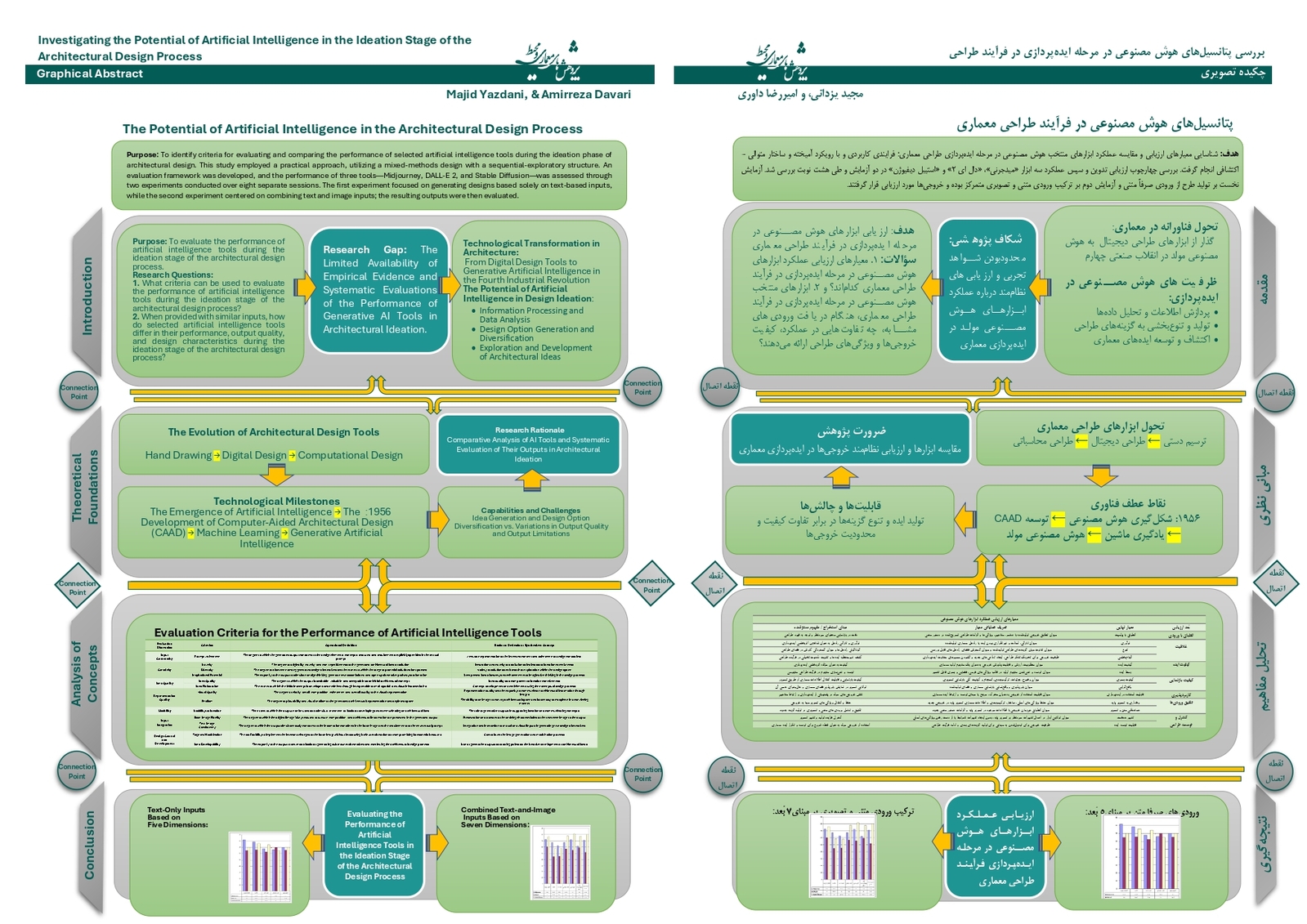
The rapid expansion of generative artificial intelligence (AI) has created new opportunities for ideation in the architectural design process. However, variations in the performance of AI tools and their dependence on the type of input underscore the need for systematic evaluation. This study aimed to identify evaluation criteria and compare the performance of selected generative AI tools during the ideation stage of architectural design. The research was applied in purpose and employed a mixed-methods approach with a sequential exploratory design. First, an evaluation framework was developed through a meta-synthesis of previous studies. Subsequently, the performance of three selected AI tools—Midjourney, DALL-E 2, and Stable Diffusion—was examined through two experiments conducted over eight iterations. The first experiment focused on design generation based solely on textual input, whereas the second examined the integration of textual and visual inputs. The generated outputs were evaluated by eight architecture professors with experience in artificial intelligence, using a five-point Likert scale. The findings of the meta-synthesis identified five dimensions for evaluating AI-generated architectural ideation: input conformity, creativity, idea quality, representational quality, and usability. In multimodal interaction, two additional dimensions were identified: multimodal input integration and design control and development. In the first experiment, Midjourney demonstrated superior performance in input conformity and creativity, Stable Diffusion performed better in idea quality, and DALL-E 2 achieved the highest performance in representational quality. Midjourney and Stable Diffusion showed comparable performance in usability. In the second experiment, Midjourney performed best in creativity and idea quality, while Stable Diffusion demonstrated superior performance across the other five dimensions. DALL-E 2 did not demonstrate superior performance in any of the evaluated dimensions. Overall, the findings indicate that the performance of generative AI tools is contingent upon the type of input and the specific design objective, and that no single tool demonstrates absolute superiority across all evaluation dimensions. Midjourney appears to be more suitable for exploring creative design ideas from text-based inputs, whereas Stable Diffusion is more appropriate for developing and controlling design alternatives through the integration of textual and visual inputs.
کلیدواژهها English