نوع مقاله : مقاله پژوهشی
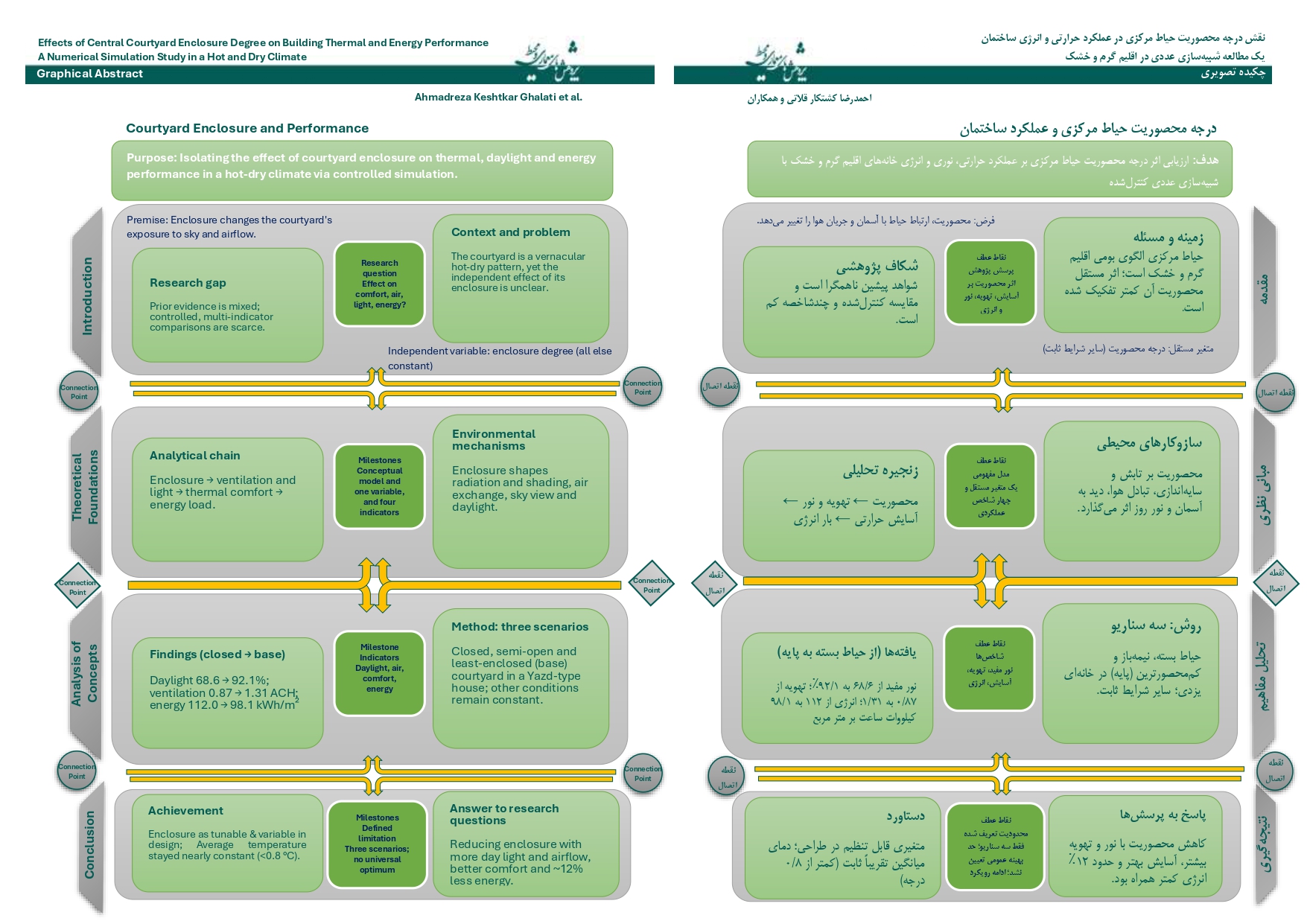
چکیده تصویری
عنوان مقاله English
نویسندگان English
Central courtyards are widely recognized as passive design elements that can influence the environmental performance of residential buildings in hot and dry climates. However, the effects of courtyard enclosure degree remain difficult to isolate because previous studies have often examined changes in courtyard geometry together with other building and operational parameters. This study investigates the effect of central courtyard enclosure degree on building performance through a controlled comparative numerical simulation approach. Three courtyard configurations, including a base case with the lowest enclosure degree, a semi-open courtyard, and a closed courtyard, were modeled using DesignBuilder with the EnergyPlus simulation engine. To enable a direct comparison, geometric characteristics, materials, building orientation, climatic data, and occupancy conditions were kept constant across the scenarios, while courtyard enclosure degree was treated as the independent variable. The performance of the three configurations was evaluated using indoor air temperature, thermal comfort indices, natural ventilation rate, useful daylight, glare, and annual energy consumption. The results indicate that, within the range of scenarios examined, lower courtyard enclosure was associated with higher natural ventilation rates, improved access to daylight, better thermal comfort conditions, and lower annual energy consumption. The lowest-enclosure base case showed the lowest annual energy consumption and lower thermal dissatisfaction compared with the more enclosed configurations. In contrast, differences in mean indoor air temperature among the scenarios were relatively limited, indicating that thermal performance cannot be explained solely by courtyard form. The findings further suggest that the environmental performance of courtyard buildings results from the interaction of enclosure degree with factors such as solar exposure, natural ventilation, and material characteristics. This finding, while preserving the value of vernacular patterns, shows that the role of design parameters is highly dependent on the conditions and how they interact. Therefore, the results should not be interpreted as evidence for a universally optimal courtyard form or a fixed enclosure threshold. Instead, courtyard enclosure can be considered a design variable whose performance implications depend on the geometric, climatic, and operational conditions of the building. The results of this study can serve as a basis for developing climate-responsive design strategies for residential buildings.
کلیدواژهها English