نوع مقاله : مقاله پژوهشی
چکیده تصویری
عنوان مقاله English
نویسنده English
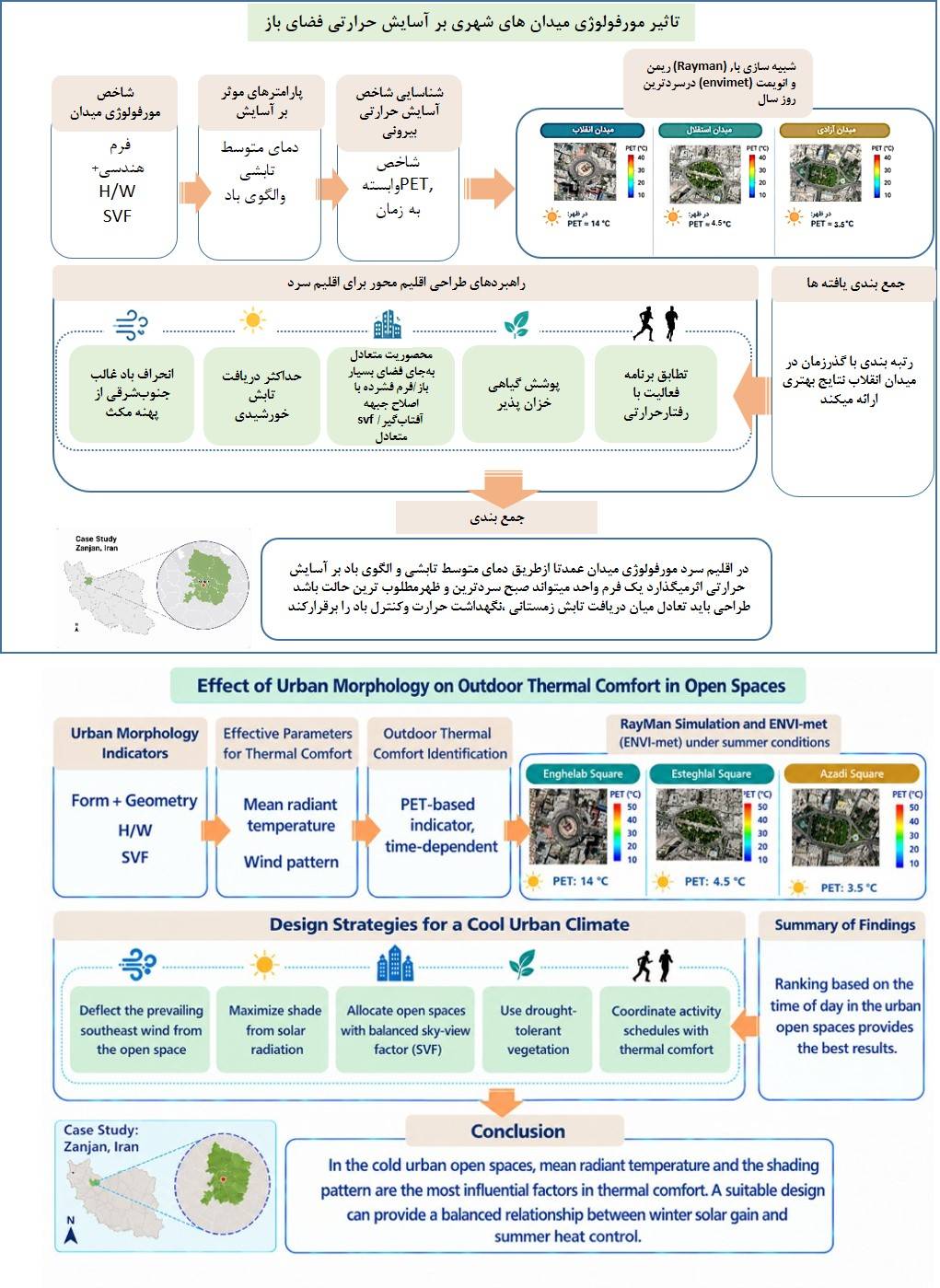
Thermal comfort is an indicator of environmental quality in urban public spaces and is influenced by the morphological characteristics of the built environment and climatic conditions. In cold climates, the organization of urban squares plays a role in improving thermal conditions and encouraging users’ presence by modifying microclimatic parameters. Despite research on microclimate simulation, the relationship between urban square morphology and thermal comfort in cold climates, particularly in Iranian cities, remains underexplored. Therefore, this study aims to investigate the effects of urban square morphology on users’ thermal comfort in cold climates and identify climate-responsive design strategies for improving the quality of these spaces. The study is applied in terms of its objective and descriptive–analytical in terms of its methodology. Three urban squares in Zanjan, Iran, with distinct morphological characteristics were investigated. The climatic and geometric characteristics of the squares were simulated using ENVI-met, while users’ thermal comfort was evaluated based on the Physiological Equivalent Temperature (PET) index. Subsequently, relationships between morphological indicators, including the degree of enclosure, H/W ratio, and sky view factor (SVF), and microclimatic parameters, including air temperature, mean radiant temperature, wind speed, and relative humidity, were examined. The results demonstrated that the morphological characteristics of the squares, particularly their geometric configuration and spatial enclosure, influence PET and users’ thermal comfort by modifying radiative conditions and airflow. Comparison of the results showed that, although Enghelab Square exhibited the lowest PET value during the morning hours, the increase in mean radiant temperature to approximately 49.6 °C during the middle of the day led to an improvement in thermal conditions, with PET reaching approximately 14 °C at noon. This finding highlights the crucial role of solar radiation exposure and urban square morphology in moderating thermal comfort in cold climates. The novelty of this study lies in elucidating the mechanisms through which urban square morphology affects thermal comfort and translating simulation results into climate-responsive design strategies for urban squares in cold climates. The findings provide a basis for designing and regenerating urban public spaces to enhance environmental quality and improve users’ thermal comfort.
کلیدواژهها English