نوع مقاله : مقاله پژوهشی
چکیده تصویری
عنوان مقاله English
نویسنده English
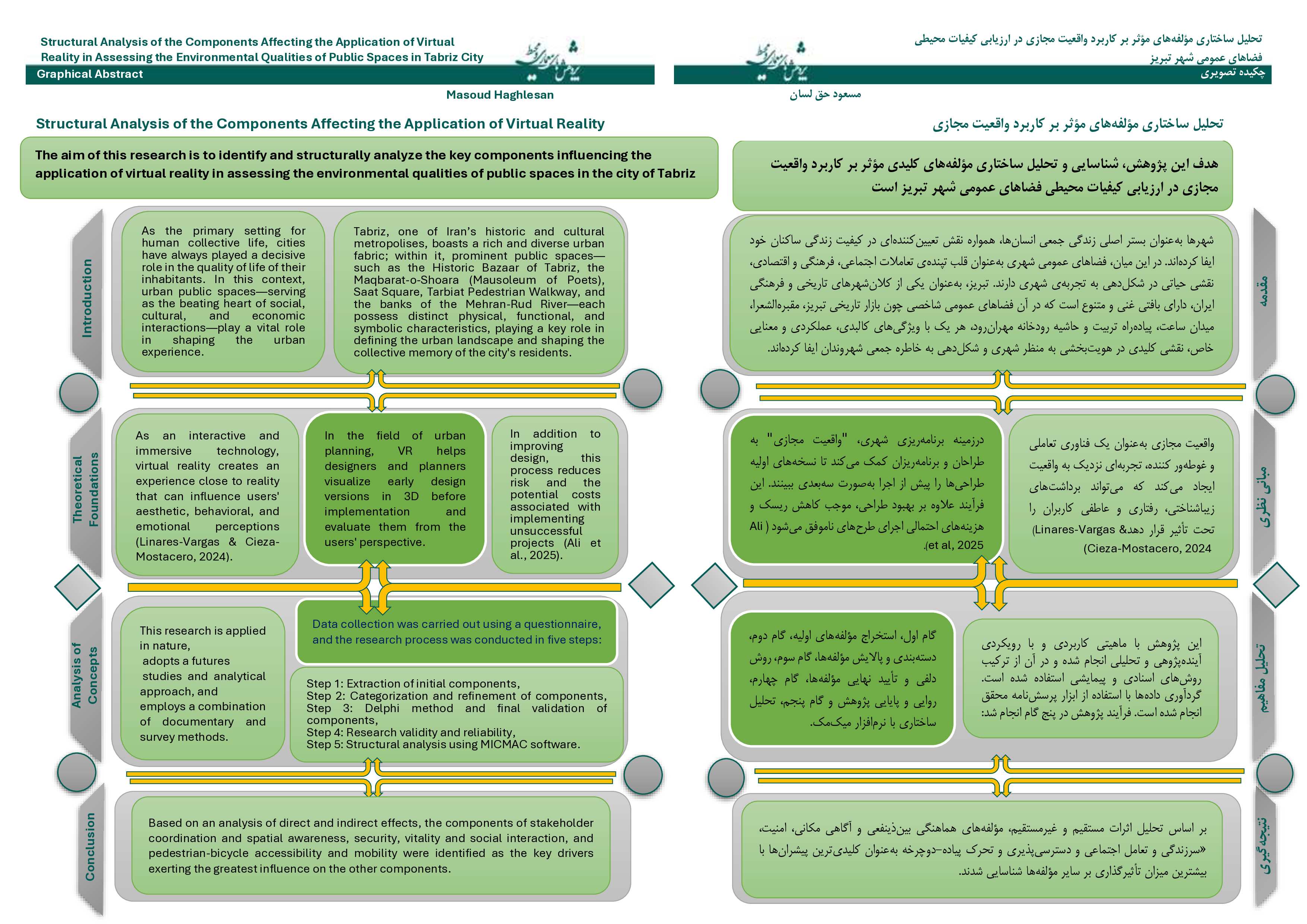
Urban public spaces, as the arena for social interactions and the identity-giving element of the urban landscape, play a decisive role in enhancing the quality of life of citizens. Virtual reality technology, as a novel and transformative tool, has made interactive and multi-sensory simulation of spaces possible prior to implementation and holds great potential for bridging the gap between design and users' perception. The aim of this study is to identify and structurally analyze the key components affecting the application of virtual reality in evaluating the environmental qualities of public spaces in the city of Tabriz. This research is applied in terms of purpose and has been conducted using a descriptive-analytical method. The present study, adopting a future-oriented approach and using the structural analysis technique (MicMac software), has identified and analyzed the interrelationships among the components. Data were collected through library studies and the opinions of 25 experts. The findings indicate that the system of components is in an unstable state, reflecting the high complexity and dynamism of the relationships among them. Based on quantitative analyses, the component "inter-stakeholder coordination and spatial awareness" with an influence score of 909 (direct) and 909 (indirect), "security (objective and subjective)" and "vitality and social interaction" with scores of 833 and 833, respectively, had the highest level of influence on other components and were identified as the key drivers in evaluating environmental qualities using virtual reality. The results show that virtual reality is not merely a tool for visual representation, but a platform for social co-creation and stakeholder participation in the design process. The findings of the structural analysis indicate that physical-functional, perceptual-sensory, social-interactive, and environmental-comfort components are the four main dimensions affecting the application of virtual reality in evaluating the environmental qualities of public spaces in Tabriz. The stated components can be employed as a strategic tool in the urban design process, participatory decision-making, design education, and evidence-based policymaking. The application of virtual reality in the process of evaluating environmental qualities is an effective step toward transitioning from traditional and subjective approaches to objective, dynamic, and user-centered evaluations.
کلیدواژهها English